
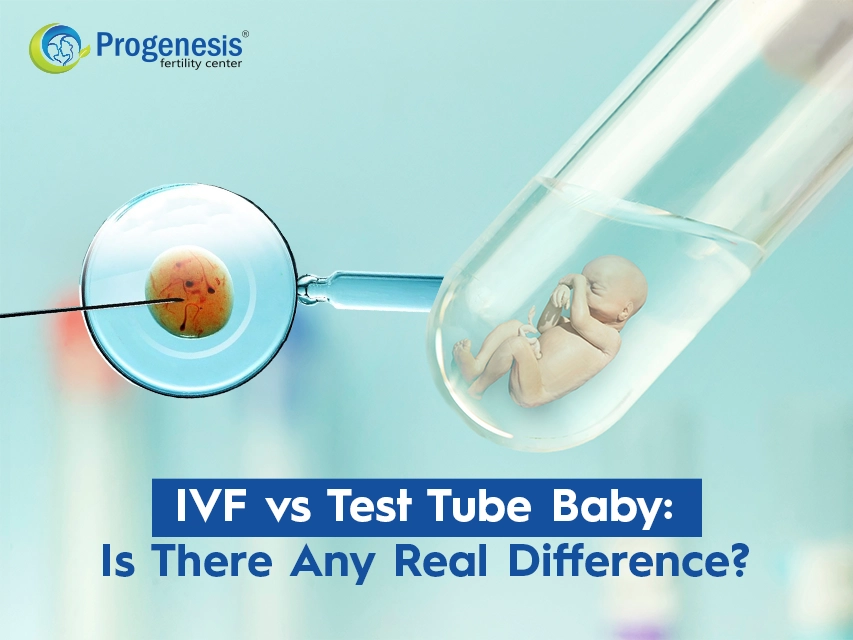
Certain terminology linked with modern artificial conception procedures confuses the general audience. IVF and test tube baby are two such terms.
IVF (In Vitro Fertilisation) is a popular infertility treatment for many couples today. In this article, we'll go over what IVF is and how it differs from a test tube baby.
What is IVF vs “Test-Tube Baby”?
IVF stands for in vitro fertilisation, and the term "vitro" indicates "happening outside the body in artificial conditions, often in a test tube. Fertilisation occurs outside of the uterus in a glass jar by mixing a female egg with a sperm. Because the egg and sperm are fertilised in a petri dish, the term "in-vitro" refers to the glass culture dish rather than the living body.
Children born via this method are known as "test tube babies" or "IVF babies." There is no distinction between the terms IVF and test tube baby. It's only that doctors use the term IVF instead of test-tube babies, while describing this treatment.
History of the Term
The term "test tube baby" is a non-medical word used decades ago to refer to IVF. The word "test tube" originated from the belief that embryos were formed in a test tube rather than a woman's fallopian tube.
Also Read: IVF vs Surrogacy – Which is better for you?
Procedural Similarities
A test tube baby is a baby conceived by IVF. The following steps are conducted in an IVF treatment process:
1) Ovulation induction: A woman receives medicine to stimulate egg production.
2) Egg retrieval: A small needle is introduced into the woman's ovary through the vagina to extract the eggs.
3) Fertilisation: The eggs and sperm are joined in a laboratory dish and fertilised.
4) Embryo transfer: The embryos are placed into the woman's uterus using a catheter (thin tube).
After this process when the embryo implants itself in the uterine lining, a successful pregnancy takes place as per natural order.
Success Rates & Outcomes
The IVF success rate ranges from 30-40% in India. This success rate of IVF is determined based on the following factors:
- The quantity and quality of the eggs or embryos utilised.
- The quantity and quality of sperm that were utilised.
- The stimulation technique conducted at the time of ovulation.
- The endometrium, or uterine lining receptivity for implantation.
- The straightforward nature of the embryo transfer procedure.
Health & Developmental Considerations
It is important to understand that the baby, whether referred to as a test tube baby or an IVF baby, is human and as natural as any other infant in all of its forms. An embryo generated through IVF is transferred to the mother's womb, and the pregnancy proceeds as usual. IVF is a safe process with no significant risks or side effects. Louis Brown was the first child born through this treatment on July 25, 1978, in Oldham, England. Following her delivery, numerous tests were conducted to make certain that her health and conditions were normal, which further ensured that IVF was as safe as a natural pregnancy.
Because of the increasing prevalence of infertility, or the inability to conceive naturally, IVF treatment is becoming more popular among Indians. The World Health Organisation classifies infertility as a condition that requires medical attention. The societal stigma connected with infertility treatments is slowly fading away as well.
Terminology Use in India
In India, IVF is often referred to as a test tube baby treatment. However, the term ‘IVF’ is also becoming well known these days.