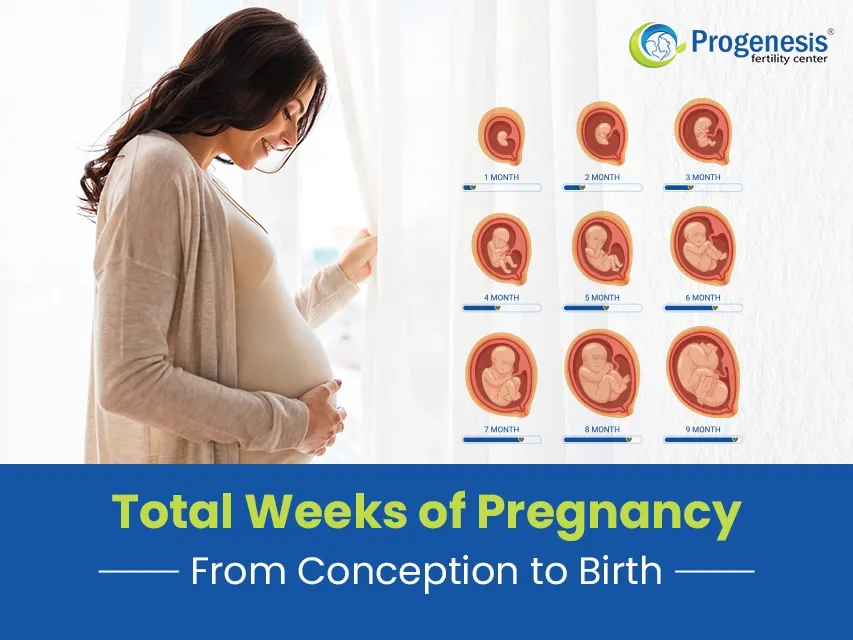
A typical pregnancy lasts approximately 40 weeks. These weeks are organised into three trimesters. By the ninth week of pregnancy, the embryo develops.
Pregnancy is typically thought of as a nine-month process. This isn't always the case, though. 40 weeks, or 280 days, is the length of a full-term pregnancy. You may be pregnant for nine or ten months, depending on the weeks you give birth and the months you are pregnant (some are shorter, some longer). This is perfectly healthy and typical.
Actually, the first day of your last menstrual period (LMP) marks the beginning of pregnancy. This is the fetus's gestational age. It occurs roughly two weeks before actual conception. The first day of your most recent period is also crucial in calculating your due date. Let’s learn the states of pregnancy in details:
Monthly Growth Stages During Pregnancy
Over the course of a normal pregnancy, the fetus will undergo significant changes. The three phases of this period are referred to as trimesters. Every trimester lasts roughly three months. It's likely that your doctor will discuss fetal development in terms of weeks. Therefore, you are approximately 12 weeks pregnant if you are three months along.
Throughout each pregnancy trimester, you will observe noticeable changes in both the foetus and yourself.
The First Trimester
The first trimester will last from conception to twelve weeks. Usually, the first three months of pregnancy are within this time frame. The fertilised egg will transform from a tiny collection of cells to a foetus that begins to take on human features throughout this trimester. In addition to being excited, the first trimester is also when most people experience uncomfortable symptoms like exhaustion and moing sickness.
Weeks 1 through 4 of the first month
The first two weeks of pregnancy are a "getting ready" time, which is unique. Your uterus gets ready for a possible pregnancy while your body gradually releases more hormones. Ovulation, or the release of an egg, occurs near the conclusion of the second week. The process of becoming pregnant continues if sperm and egg come into contact shortly after ovulation.
Week 3: The third week is when fertilisation takes place. A zygote is formed when an egg and sperm unite.
Week 4: The small cluster of cells develops into a blastocyst, which implants into the lining of your uterus. What will eventually become the placenta begins to develop. The blastocyst is surrounded by a watertight sac. During pregnancy, this amniotic sac cushions the developing foetus.
The blastocyst is roughly two millimetres (mm) long at the end of the fourth week, which is the size of a poppy seed.
Also Read: Top 10 Common Questions about Pregnancy Answered
Weeks 5 through 8 of the second month
Most people become aware that they are pregnant around the second month of pregnancy. An at-home pregnancy test will come back positive by the fifth week or so, when pregnancy hormones are in full swing. Many people start experiencing pregnancy symptoms at this point.
Week 5: The neural tube is formed, which includes the brain, spinal cord, and other central nervous system neural tissue. By the end of the fifth week, the little "heart" tube will pulse 110 times per minute.
Week 6: Little buds that will grow into arms and legs also begin to form. Circulation will start as the blood cells take shape. The structures that will eventually become the mouth, eyes, and ears begin to form. On a vaginal ultrasound, your doctor can most likely find pulses in the group of cells that will make up the heart.
Week 7: Genitals start to form as soft cartilage is replaced by bones. The head of the embryo is larger than the rest of its body. Because of its big head and pronounced tail that recedes, some people believe the embryo looks like a miniature seahorse or tadpole.
Doctors and nurses call the embryo a foetus after the eighth week. Until it is born, it will remain a foetus.
The foetus is roughly the size of a black bean by the end of the second month, measuring between 0.5 and 1 inch (in).
Also Read: Understanding your cycle and time for conception
Weeks 9 through 12 of the third month
The transformation of an embryo into a fetus occurs during the third month of pregnancy. It's a time of tremendous expansion and advancement. The fetus develops unique organs, limbs, muscles, bones, and facial traits. The fetus will have a designated sex by the end of the 12th week, but an ultrasound won't show it for a few more weeks.
Week 9: Taste buds and teeth begin to develop. Its body shape becomes more human-like as its muscles begin to develop. However, half of its length is still in its skull. With a Doppler ultrasound, your physician might be able to hear the heartbeat.
Week 10: There are no more webbed fingers; the arms, hands, fingers, feet, and toes are all fully formed. Exteal ears are starting to form, and fingeails and toenails are starting to grow. Although they are too early to be seen on an ultrasound, the exteal genitals also start to form.
Week 11: By opening and closing its lips and fists, the foetus is beginning to move around a little. Although it's too early to feel any kicks, its knees, elbows, and ankles are functioning. Its skin is still translucent, but the bones are hardening. Features on the face are more noticeable.
Week 12: Every organ, limb, bone, and muscle is there and will keep growing until it is completely functional. The liver generates bile, and the digestive, urinary, and circulatory systems are all functioning. Amniotic fluid is being consumed and expelled by the foetus.
After 12 weeks (the end of the first trimester), your likelihood of miscarrying decreases significantly because the most important development has occurred. At this point, the majority of people also start to have less moing sickness.
The foetus is around the size of a plum at the end of the third month, measuring 2.5 to 3 inches in length.
Also Read: Women's Age & Pregnancy: Impact on Fertility & Motherhood
The Second Trimester
Many people believe that the second trimester of pregnancy is the most enjoyable. By this point, the discomfort of early pregnancy has likely subsided and any moing sickness has disappeared. You may also start to feel movement as the fetus flips and tus in your uterus.
Weeks 13 through 16 of the fourth month
At this stage of pregnancy, many people start exhibiting signs of pregnancy. With a Doppler ultrasound, your pregnancy care provider can clearly hear the foetal heartbeat. The fetus can even stretch, yawn, make faces, and suck its thumb.
Week 13: The fetus's huge head starts to expand proportionately to its body, and vocal cords begin to form.
Week 14: Fine hair starts to form as the fetus's skin thickens. It has the ability to turn its head and begin putting its fingers to its mouth. Fingerprints start to form, and exteal genitalia reach full development.
Week 15: The intestines, ears, and other organs start relocating to their permanent positions. The fetus's lungs are starting to form, but it still practices breathing using amniotic fluid. The fetus starts to move with greater intention, such as smiling or sucking its thumb.
Week 16: The fetus's ears are sufficiently developed to hear you speak, and it has lips. The fetus can respond to light by rotating away from it, even when its eyes are closed.
The fetus weighs about 4 ounces and is about 5 inches long by the end of the fourth month. That is roughly the size of an avocado for comparison.
Also Read: What is HCG? Role of the Pregnancy Hormone Explained
Weeks 17 through 20 of the fifth month
Most pregnant women start to feel the foetus moving around by the end of the fifth month. Quickening is the term for the initial motions, which may resemble a flutter. You will eventually have your first ultrasound if your pregnancy has been healthy thus far. You might even be able to determine the sex assigned to the foetus.
Week 17: Although the fetus's skin is still thin, it will begin to gain fat. A white substance known as veix covers its skin. It is believed that this "cheesy" material shields foetal skin from prolonged exposure to amniotic fluid.
Week 18: Lanugo, a hair that resembles peach fuzz, covers the foetus. It offers an additional layer of protection and aids in keeping the fetus warm. The fetus might have a sleep-wake cycle, and if it's asleep, strong noises could wake it up.
Week 19: Most people start to feel kicks and punches as the foetus grows stronger. In addition, the fetus can hiccup and has its own distinct set of fingerprints.
Week 20: The fetus's nails begin to grow toward the tips of its fingers. The development of the part of the brain that controls the five senses starts.
The foetus weighs roughly one pound and measures nine to ten inches in length by the end of the fifth month.
Weeks 21 through 24 of the sixth month
If you could look inside your uterus right now, you would see that the fetus's skin is transparent, wrinkled, and reddish in colour. Its eyelids start to separate in the sixth month of pregnancy, and you can observe frequent, jerky movements. The foetus moves or intensifies its heartbeat in response to noises.
Week 21: Coordinated and frequent limb movements. The bone marrow in the foetus helps in the production of blood cells.
Week 22: The foetus can now touch its ears and the umbilical cord, and its grasp is growing stronger. It has the ability to hear your breathing, heartbeat, and stomach rumble.
Week 23: With intense care, the fetus may survive past the 23rd week if it is born prematurely. It will start rapidly gaining body fat.
Week 24: Although the fetus's lungs are fully formed, they are still too immature to function outside of your uterus.
The foetus is around 12 inches long and weighs around 2 pounds by the end of the sixth month.
Weeks 25 through 28 of the seventh month
The fetus keeps growing and building up its body fat reserves. The fetus frequently shifts positions and reacts to light, sound, and discomfort. The amount of amniotic fluid starts to decrease.
Week 25: The fetus's skin becomes plumper and less wrinkled as it has more body fat. Its neurological system is developing rapidly.
Week 26: Melanin, the chemical that gives skin and eyes their colour, is produced by the fetus. The production of surfactant, which helps in breathing after delivery, begins in the fetus's lungs.
Week 27: The fetus is able to blink and open its eyes. It has eyelashes as well.
Week 28: As the fetus prepares for delivery, it may start to turn head-down in your uterus.
The fetus weighs between two and three pounds at the end of the seventh month and is roughly 14 to 15 inches in length.
Also read: Implantation Symptoms: Is It a Sign of Pregnancy?
The Third Trimester
This is when your pregnancy ends. Every week of this last stage of development helps the fetus get ready for delivery, even if you might be tempted to start counting down the days until your due date and hope it arrives early. The foetus rapidly increases weight during the third trimester, acquiring body fat that will be beneficial after birth.
As your due date draws near, your doctor will keep a careful eye on you. You will first see your doctor every two weeks, and subsequently every week. If you have any questions conceing labour and delivery, be sure to ask your doctor.
Weeks 29 through 32 of the eighth month
The fetus keeps growing and building up its body fat reserves. During this period, the brain develops at its fastest rate. Most stimuli are visible and audible to the foetus. The lungs may still be immature, but the majority of the inteal systems are fully formed.
Week 29: Now that the fetus is cramping in the amniotic sac, you could notice that the kicks and jabs seem more like pokes.
Week 30: The fetus is able to regulate its own body temperature. Its brain is developing and expanding quickly.
Week 31: More sensations and information can be processed by the fetus. When it's awake and when it's asleep, you can definitely see more noticeable pattes.
Week 32: The skin of the fetus is no longer transparent. The majority of the organs are developed and prepared for delivery, with the exception of the brain and lungs.
The fetus weighs up to five pounds and is between seventeen and eighteen inches long.
Also read: How to Deal with Two Weeks Wait
Weeks 33 through 36 of the ninth month
The fetus continues to develop and expand during this phase. At this stage of pregnancy, the lungs are almost fully grown. During the ninth month, growth and brain development are primarily finalised.
Week 33: Except for the cranial bones surrounding the brain, which must remain soft in order to pass through the birth canal, the fetus's bones are hardening.
Week 34: The fetus's skin-protecting veix begins to thicken.
Week 35: Although the fetus's brain is still developing, its birth weight is still just two-thirds of its full potential.
Week 36: The foetus develops hair on its head and loses its lanugo.
The fetus weighs about 6 to 7 pounds and is roughly 17 to 19 inches in length.
Weeks 37 through 40 of Month 10
You could give birth at any point during this last month. The position of the fetus may have changed at this time in preparation for delivery. It should ideally be in your uterus head-down. As the fetus descends into your pelvis and is ready to be born, you could experience extreme discomfort during this last phase. To measure how much the fetus moves, your doctor can advise you to do kick counts.
Week 37: The toenails of the foetus grow to the tips of its toes. The fetus may begin to descend toward your pelvis.
Week 38: In order to reach its final size, the foetus is gaining 0.5 pounds every week.
Week 39: The foetus has reached full term and is prepared to be born!
Week 40: This is the week of your due date. If you see any indications of labour, give your doctor a call.
The fetus weighs roughly 7 to 9 pounds and is about 18 to 20 inches in length.
Conclusion
Each trimester or stage of pregnancy poses its own set of risks. It's difficult to identify specific weeks as being more or less crucial. Most healthcare practitioners, however, agree that the first 13 weeks of pregnancy (or the first trimester) are critical for foetal development. The chance of miscarriage decreases after the first trimester, when the fetus's major organs and systems develop and function. This does not imply that your pregnancy becomes less vital after 13 weeks. It simply indicates that many key procedures and processes have been completed, and your body is ready to carry out the rest of the pregnancy