
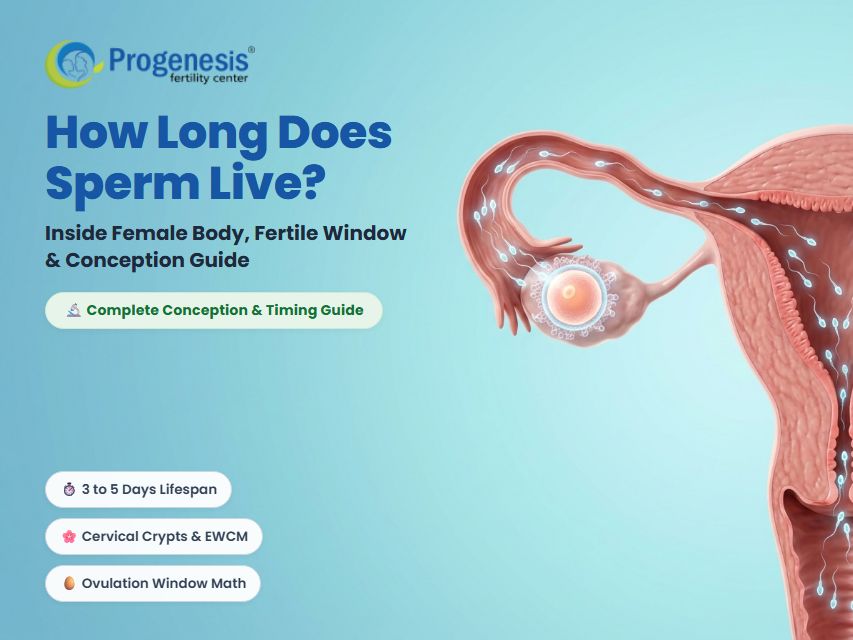
When trying to conceive—or when evaluating the risk of an unintended pregnancy—one of the most critical questions couples ask is: "How many days does sperm live in the female body?"
Many people assume that fertilisation requires having intercourse at the exact hour an egg is released. However, human reproductive biology is far more forgiving. While a mature human egg survives for only 12 to 24 hours after ovulation, healthy sperm can survive inside a woman's reproductive tract for an average of 3 days, and up to 5 days (and rarely up to 7 days) under optimal biological conditions.
This remarkable survival window is the sole physiological reason why the human "fertile window" spans approximately six days each month. Understanding how sperm navigates the acidic vagina, takes refuge in fertile cervical mucus, and joueys to the fallopian tubes allows couples to accurately time intercourse for peak pregnancy rates or optimize assisted reproduction protocols like Intrauterine Insemination (IUI) and In Vitro Fertilization (IVF).
In this clinical guide, senior reproductive endocrinologists and embryologists at Progenesis Fertility Center break down the exact sperm survival timeline by anatomical zone, the role of cervical mucus, day-by-day conception probabilities, and medical facts about sperm longevity.
The Core Answer: Sperm Survival Timeline Across Anatomical Zones
The lifespan of a sperm cell is not fixed—it depends entirely on where it lands and the hormonal environment of the female reproductive tract at that specific moment.
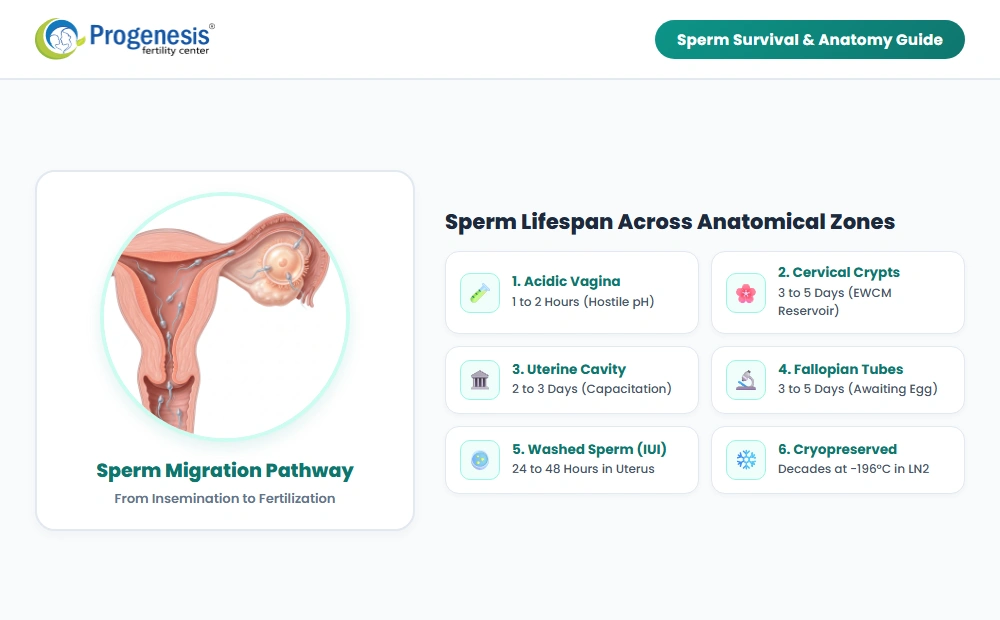
1. The Acidic Vagina: 1 to 2 Hours
The normal vaginal canal is naturally acidic, with a low pH ranging between 3.8 and 4.5, maintained by protective Lactobacillus bacteria to ward off microbial infections. While this acidity is vital for female health, it is lethal to sperm.
* Although alkaline seminal fluid temporarily buffers the acidity, the vast majority of sperm trapped in the lower vagina perish within 60 to 120 minutes.
* Only the fastest, progressively motile sperm escape this hostile environment by entering the cervical canal within minutes of ejaculation.
2. The Cervix & Cervical Crypts: 3 to 5 Days
The cervix serves as the gateway to the upper reproductive tract. During the fertile pre-ovulatory phase, high estrogen levels transform cervical mucus into a clear, watery, stretchy substance called egg-white cervical mucus (EWCM).
* Fertile cervical mucus has an alkaline pH (7.0 to 8.5), which neutralizes vaginal acid and nourishes sperm cells.
* The microscopic architecture of the cervix contains specialized micro-grooves called cervical crypts. These crypts act as protective reservoirs, shielding sperm from immune destruction and gradually releasing waves of viable, capacitated sperm into the uterus over 72 to 120 hours (3 to 5 days).
3. The Uterine Cavity: 2 to 3 Days
Once sperm pass through the inteal cervical os, they enter the uterine cavity. Guided by uterine contractions (peristalsis) and specialized fluid currents, sperm traverse the uterine cavity over several hours. Viable sperm can reside within the nutrient-rich endometrial lining for 24 to 72 hours.
4. The Fallopian Tubes (Ampulla): 3 to 5 Days
The outer third of the fallopian tube—known as the ampulla—is the anatomical site where fertilization actually occurs. Sperm that successfully reach the fallopian tubes bind to the tubal epithelial lining, which preserves their membrane stability and motility.
* Sperm can survive here in a suspended, ready state for up to 5 days, waiting for the ovary to release an oocyte.
5. Outside the Body, Water, and Assisted Lab Conditions
- Dry Surfaces (Clothing, Skin, Sheets): Sperm cannot survive once seminal plasma evaporates. On dry surfaces, sperm die within a few minutes.
- Warm Water / Bath / Hot Tubs: Sperm dispersed in warm water die within seconds to minutes due to osmotic shock, temperature shock, and chlorinated chemicals.
- Washed Sperm (IUI Procedure): When semen is processed in an embryology lab to isolate pure motile sperm, the protective seminal plasma is removed. Washed sperm injected directly into the uterus survives for 24 to 48 hours.
- Liquid Nitrogen (Cryopreservation): Sperm frozen at -196°C in specialized cryoprotectant media remains biologically viable for decades.
Sperm Lifespan by Anatomical Environment & Clinical Setting
| Environment / Anatomical Location | Typical Lifespan | Primary Biological Mechanism | Fertility Significance |
|---|---|---|---|
| Vaginal Canal | 1 to 2 hours | Acidic environment (pH 3.8–4.5) destroys sperm membranes. | Hostile barrier; weeds out weak or abnormal sperm. |
| Cervical Mucus (EWCM) | 3 to 5 days | Alkaline pH (7.0–8.5) and glycoprotein channels nourish sperm. | Primary reservoir storing sperm prior to ovulation. |
| Uterine Cavity | 2 to 3 days | Endometrial fluid provides glucose and supports capacitation. | Transit pathway and functional maturation zone. |
| Fallopian Tube (Ampulla) | 3 to 5 days | Tubal epithelial cells maintain membrane integrity. | Ideal waiting station for egg release and fertilization. |
| Dry Surfaces (Air / Fabric) | Minutes | Rapid dehydration and denaturation of cell enzymes. | No risk of pregnancy once semen dries. |
| Water / Swimming Pool | Seconds | Osmotic lysis, chemical toxicity, and dilution. | Pregnancy from swimming pool water is a biological myth. |
| Washed Sperm (IUI Insemination) | 24 to 48 hours | Highly motile fraction in nutrient media without seminal plasma. | Precise IUI timing required (24–36h post-trigger). |
| Cryopreservation (-196°C) | Decades (Indefinite) | Metabolic processes halted in liquid nitrogen. | Preserves male fertility for future IVF/ICSI cycles. |
Also Read: Ovulation Period, Symptoms and Best Days to Conceive
Why Fertile Cervical Mucus is the Key to Sperm Longevity
Many women track ovulation using calendar apps alone, but the true regulator of sperm longevity inside your body is cervical mucus quality.
┌────────────────────────────────────────────────────────┐ │ THE SPERM SURVIVAL TRANSFORMATION │ └──────────────────────────┬─────────────────────────────┘ │ ┌───────────────────┴───────────────────┐ ▼ ▼ ┌────────────────────────┐ ┌────────────────────────┐ │ NON-FERTILE PHASE │ │ FERTILE WINDOW (ESTROGEN)│ ├────────────────────────┤ ├────────────────────────┤ │ • Low Estrogen / High P│ │ • High Estradiol (E2) │ │ • Thick, sticky mucus │ │ • Clear, stretchy EWCM │ │ • Acidic pH (Hostile) │ │ • Alkaline pH (7.5–8.5)│ │ • Dense mesh blocks │ │ • Parallel micelle rows│ │ • Sperm dies in hours │ │ • Sperm lives 3–5 days │ └────────────────────────┘ └────────────────────────┘ Throughout the majority of your menstrual cycle, the cervix is sealed by a thick, cellular mucus plug driven by progesterone. This mucus acts as a physical and chemical barricade, trapping sperm and subjecting them to rapid phagocytosis by white blood cells.
However, during the 5 to 6 days leading up to ovulation, developing ovarian follicles produce surging amounts of estradiol (estrogen). This estrogen surge triggers the cervical glands to secrete high-grade, estrogenic mucus known as Type E (Egg-White) Cervical Mucus:
1. Biochemical Protection: EWCM is 95% water and rich in electrolytes, glucose, amino acids, and alkaline salts, providing essential fuel to power sperm flagella.
2. Microscopic Swim Lanes: Under a microscope, EWCM arranges into parallel micelle channels that guide sperm directly upward while filtering out morphologically abnormal cells and debris.
3. Cervical Crypt Storage: It allows sperm to settle into micro-folds within the cervical canal, protecting them from the body's immune system and releasing them in controlled waves toward the fallopian tubes over several days.
What is Sperm Capacitation?
Ejaculated sperm are not immediately capable of fertilizing an egg. To become fertilization-competent, sperm must undergo capacitation—a series of biochemical transformations that occur inside the female reproductive tract over 5 to 7 hours:
* The protective cholesterol and glycoprotein coat covering the sperm head is stripped away by enzymes in uterine and tubal fluids.
* Calcium influx increases intracellular pH, triggering hyperactivation—a vigorous, whip-like swimming motion that gives sperm the mechanical thrust needed to penetrate the outer layer (zona pellucida) of the ovum.
Because capacitation takes hours, having sperm arrive in the fallopian tube before ovulation occurs ensures that fully primed, hyperactivated sperm are ready the exact minute the egg is released.
The 6-Day Fertile Window: Timing Intercourse for Peak Pregnancy Odds
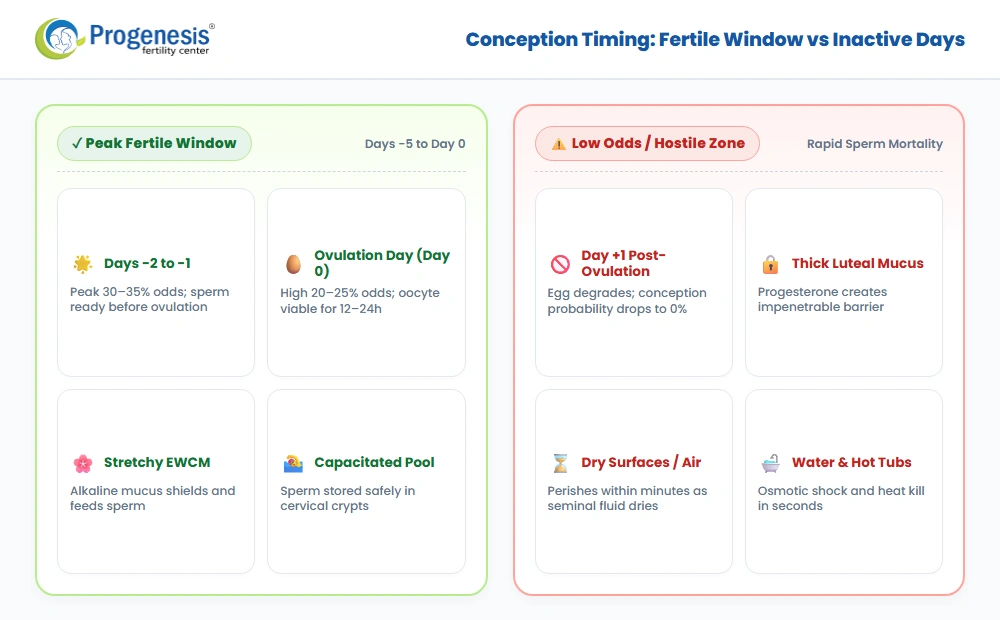
Because sperm lives up to 5 days and an unfertilized egg survives for only 12 to 24 hours, the biological window for conception is strictly 6 days long: the 5 days before ovulation plus the day of ovulation itself.
Why Having Sex BEFORE Ovulation Beats Having Sex ON Ovulation Day
A common misconception among couples trying to conceive is that ovulation day offers the highest chance of pregnancy. Clinical reproductive studies show that having intercourse 1 to 2 days before ovulation actually produces significantly higher pregnancy rates than having intercourse on ovulation day itself:
- Sperm Needs Travel Time: It takes sperm anywhere from 15 minutes to several hours to navigate the cervix, uterus, and fallopian tubes, followed by 5 to 7 hours of capacitation.
- The Egg Has a Short Lifespan: Once an oocyte leaves the follicle, its quality deteriorates rapidly after 12 hours. If you wait until ovulation has occurred to have intercourse, the egg may already be past its peak viability before sperm can complete capacitation.
- The "Waiting Army" Strategy: When intercourse occurs 2 days prior to ovulation (Day -2) or 1 day prior (Day -1), viable, capacitated sperm are already stationed in the ampulla of the fallopian tube, ready to fertilize the egg the instant it emerges.
Day-by-Day Conception Probability Matrix Relative to Ovulation
| Day Relative to Ovulation | Sperm Viability Status | Conception Probability | Clinical Timing Recommendation |
|---|---|---|---|
| Day -5 (5 Days Before) | Sperm can survive if fertile EWCM is present. | 10% – 12% | Good starting point for frequent intercourse. |
| Day -4 (4 Days Before) | Surviving sperm enter cervical crypt storage. | 15% – 18% | Favorable conception window. |
| Day -3 (3 Days Before) | High survival rate in estrogen-rich mucus. | 22% – 25% | Highly fertile day. |
| Day -2 (2 Days Before) | Optimal survival; sperm reach ampulla early. | 30% – 35% (PEAK) | Best day for natural conception. |
| Day -1 (1 Day Before) | High density of fresh, capacitated sperm. | 28% – 33% (PEAK) | Second best day for natural conception. |
| Day 0 (Ovulation Day) | Egg is freshly released; sperm must swim fast. | 20% – 25% | Viable, but time-sensitive window. |
| Day +1 (1 Day After) | Egg begins to degrade; cervical mucus thickens. | < 1% – 2% | Conception window effectively closed. |
| Day +2 to +14 (Luteal) | Progesterone plug seals cervix; no egg present. | 0% | Non-fertile post-ovulatory phase. |
Also Read: What is a Normal Sperm Count? Range, Motility, and Semen Analysis
Factors That Impact How Long Sperm Survives
Not all sperm survive for the theoretical maximum of 5 days. Sperm longevity varies based on both male semen parameters and the female pelvic environment.
Male Factors Influencing Sperm Longevity:
- Progressive Motility & Morphology: Only sperm with straight-line progressive motility (Grade A/B) and normal oval head morphology can penetrate cervical mucus and reach the fallopian tubes. Men with low motility (asthenozoospermia) see rapid sperm mortality in the lower reproductive tract.
- Seminal Fluid Quality: Seminal vesicle and prostate secretions contain fructose, zinc, and prostaglandins that nourish sperm and suppress female immune responses. Chronic prostate or seminal vesicle infections impair this protective buffer.
- Oxidative Stress & DNA Fragmentation: Elevated reactive oxygen species (ROS) from smoking, varicocele, obesity, or heat exposure damage sperm cell membranes, drastically reducing their lifespan inside the female body.
Female Factors Influencing Sperm Longevity:
- Hostile Cervical Mucus: Low estrogen levels, chronic cervicitis, or medications like clomiphene citrate (which has an anti-estrogenic drying effect on the cervix) can cause thick, acidic mucus that immobilizes sperm within hours.
- Vaginal Microbiome Imbalances: Conditions like Bacterial Vaginosis (BV) or vaginal infections increase inflammatory white blood cells that actively attack and ingest sperm cells.
- Anti-Sperm Antibodies (ASA): In some women, the immune system mistakenly recognizes sperm proteins as foreign invaders, producing antibodies in cervical mucus that cause sperm to clump (agglutinate) and die prematurely.
Sperm Longevity in Assisted Reproductive Technology (ART)
In fertility treatments, sperm handling and timing protocols are strictly calibrated around cellular lifespans:
1. Intrauterine Insemination (IUI)
In an IUI cycle, semen undergoes laboratory "washing" to isolate the most motile, morphologically normal sperm from seminal plasma, prostaglandins, and dead cells.
* Because washed sperm bypasses the protective cervical crypts and is placed directly into the uterine cavity, its lifespan is shorter—typically 24 to 48 hours.
* For this reason, reproductive specialists schedule IUI precisely 36 to 40 hours after administering an hCG ovulation trigger shot to ensure that sperm and egg meet at their simultaneous peak viability.
2. In Vitro Fertilization (IVF) & ICSI
In IVF and ICSI, sperm cells are placed in specialized incubator culture media maintained at exact physiological temperature (37°C), carbon dioxide, and oxygen levels.
* In culture media, capacitated sperm can maintain progressive motility for 48 to 72 hours.
* In Intracytoplasmic Sperm Injection (ICSI), only a single healthy sperm is required, which is injected directly into the cytoplasm of a mature egg, bypassing all anatomical barriers and survival hurdles entirely.
3. Sperm Cryopreservation
Through modern rapid-freezing protocols using liquid nitrogen, human sperm cells are frozen at -196°C. At this temperature, all metabolic and enzymatic activity stops completely. Clinical data demonstrates that sperm frozen for 20 to 30+ years retains identical fertilization and live birth rates compared to freshly collected gametes.
Also Read: Artificial Insemination (IUI) Treatment: Procedure, Success Rate & Care
Debunking Common Myths About Sperm Survival
Myth 1: Can you get pregnant from pre-ejaculate (precum)?
Medical Reality: Yes. While pre-ejaculatory fluid produced by the Cowper's glands does not inherently contain sperm, studies show that viable sperm left behind in the urethra from prior ejaculations can be swept into pre-ejaculate. If pre-cum enters the vagina during the fertile window, those sperm can survive in cervical mucus and cause pregnancy.
Myth 2: Can sperm survive in a hot tub, swimming pool, or bath?
Medical Reality: No. Sperm cannot swim through a pool or bath water to enter a woman's reproductive tract. Exposure to chlorinated water, bath soap, heat, and osmotic dilution kills sperm cells within seconds. Pregnancy can only occur through direct penetrative sexual intercourse or assisted insemination.
Myth 3: How does sperm lifespan relate to the Emergency Contraceptive Pill?
Medical Reality: Moing-after pills (such as Levonorgestrel or Ulipristal Acetate) are effective for 72 to 120 hours (3 to 5 days) precisely because sperm can survive in the female body for up to 5 days. Emergency contraceptives work primarily by delaying or preventing ovulation until the surviving sperm have naturally died off.
Myth 4: Does lying down with your legs elevated after intercourse keep sperm alive longer?
Medical Reality: While resting for 10 to 15 minutes after intercourse is a harmless practice, elevating your legs does not alter sperm lifespan. Progressively motile sperm enter the cervical mucus within 2 to 5 minutes of ejaculation regardless of body posture. Fluid that leaks out afterward consists almost entirely of seminal fluid, prostate secretions, and non-motile cells.
Frequently Asked Questions (FAQs)
1. How many days does sperm live in a woman's body?
Inside the female reproductive tract, sperm lives for an average of 3 days. Under ideal conditions with fertile, estrogen-rich cervical mucus, healthy sperm can survive for up to 5 days (and rarely up to 7 days) in the cervix and fallopian tubes while awaiting ovulation.
2. Can you get pregnant from sex 5 days before ovulation?
Yes. Because healthy sperm can survive in fertile cervical mucus for up to 5 days, intercourse taking place 5 days before ovulation carries a 10% to 12% probability of conception. The sperm remains safely stored in the cervical crypts and fallopian tubes until the egg is released.
3. How long does sperm survive on bed sheets, skin, or clothes?
Sperm deposited on exteal surfaces such as clothing, bed sheets, or skin dies within a few minutes. Once the seminal fluid dries, the sperm cells dehydrate and permanently lose all viability. It is impossible to get pregnant from dried semen.
4. What happens to sperm that doesn't fertilize the egg?
The vast majority of ejaculated sperm—over 99%—never reach the egg. Sperm cells that remain in the acidic vagina die within hours and are expelled naturally. Sperm in the uterus and tubes that do not fertilize the egg naturally break down and are safely cleared away by the female immune system (macrophages).
5. How long does washed sperm live during an IUI procedure?
During an Intrauterine Insemination (IUI), sperm is washed to remove seminal plasma and injected directly into the uterine cavity. Because it bypasses the cervical mucus reservoir, washed sperm typically survives for 24 to 48 hours, which is why IUI procedures are carefully timed around ovulation triggers.
6. Why does sperm die so fast in the vagina?
The vagina has an acidic pH (between 3.8 and 4.5) to protect against harmful bacterial and fungal infections. This acidic environment is toxic to sperm, causing most sperm cells left in the vagina to become immobilized and die within 1 to 2 hours of ejaculation.
7. Which day of the cycle has the highest chance of pregnancy?
The highest chance of pregnancy occurs from intercourse taking place 1 to 2 days before ovulation (Days -2 and -1). Having sex on these days gives sperm sufficient time to undergo capacitation and wait in the fallopian tubes, yielding conception rates of 30% to 35%.
8. Does frequent ejaculation reduce sperm lifespan?
Frequent ejaculation (every 1 to 2 days) does not shorten sperm lifespan inside the female body. In fact, regular ejaculation lowers oxidative stress, improves progressive motility, and reduces sperm DNA fragmentation, creating healthier sperm that survive longer in the female reproductive tract.
Summary & When to Consult a Fertility Specialist
Human sperm survival is an extraordinary biological adaptation: by living up to 5 days within fertile cervical mucus, sperm extends the human reproductive window, tuing a brief 12-hour ovulation event into a 6-day fertile window.
If you are tracking your cycle and planning to conceive:
* Aim to have intercourse every 1 to 2 days during your fertile window (the 5 days leading up to and including ovulation).
* Pay close attention to changes in your cervical mucus—stretchy, egg-white mucus is nature's sign that sperm will survive for days inside your reproductive tract.
* If you have been having well-timed intercourse during your fertile window for 12 months (or 6 months if the female partner is 35 or older) without achieving pregnancy, underlying male or female fertility factors may be affecting sperm survival, fallopian tube patency, or ovulation.
At Progenesis Fertility Center, our expert fertility doctors and embryologists perform comprehensive male semen analysis, follicular monitoring, and advanced reproductive treatments to help couples identify roadblocks and achieve healthy pregnancies.
👉 Book a Free Fertility Consultation at Progenesis IVF or call our helpline at +91 70309 44041 to speak with our fertility experts today.